 Add to Chrome
 Add to Firefox
 Add to Edge
AIRGuard: Guarding Agent Actions with Runtime Authority Control
May 27, 2026
Tool-using language agents turn model decisions into external side effects: they read files, run scripts, call APIs, send messages, and invoke Model Context Protocol tools. This makes agent attacks different from jailbreaks. The harmful step is often not an obviously forbidden output, but an ordinary executable action that becomes unsafe because attacker-controlled context steers authorized access against the user's interest. We identify this failure mode as authority confusion: untrusted resources may inform reasoning, but they must not authorize side effects. We present AIRGuard, a runtime guard that operationalizes least privilege as action-time authorization. AIRGuard normalizes heterogeneous tool calls, derives task authority into step-level authority, tracks source and target trust, simulates sensitive side effects, audits cross-step risk, and enforces decisions before actions execute. On AgentTrap, AIRGuard reduces Sonnet 4.6 attack success from 36.3% without defense to 5.5%. On DTAP-150, AIRGuard preserves 76.0% benign utility with Haiku 4.5, compared with 52.0% for ARGUS and 42.0% for MELON. An ablation further shows that prompt-only policy helps only modestly, whereas a dedicated runtime authority-control layer gives the agent system direct control over tool-mediated side effects. Code and data are available at https://github.com/Sophie508/AIRGuard.

AgentTrap: Measuring Runtime Trust Failures in Third-Party Agent Skills
May 13, 2026Third-party skills are becoming the package ecosystem for LLM agents. They package natural-language instructions, helper scripts, templates, documents, and service configuration into reusable workflows. This makes skills useful, but it also introduces a new security problem: a malicious skill does not need to ask the model to perform an obviously harmful action. Instead, it can disguise the harmful behavior as part of a routine workflow, relying on the agent to execute that workflow with high-value permissions and limited human supervision. We introduce AgentTrap, a dynamic benchmark for evaluating whether LLM agents can use third-party skills while resisting malicious runtime behavior. AgentTrap contains 141 tasks: 91 malicious tasks and 50 benign utility tasks, covering 16 security-impact dimensions grounded in agent-skill supply-chain threats. In each task, the agent receives an ordinary user request, runs with installed skills that may contain malicious workflow elements, and is executed in a sandboxed environment. AgentTrap then judges complete trajectories for attack success, blocked or refused behavior, attack-not-triggered cases, and no-attack-evidence outcomes. Our central finding is that the most informative failures are not simple jailbreaks. Models often complete the visible user task while treating unsafe side effects introduced by the skill as part of the normal workflow. This motivates runtime evaluation of the concrete model--framework--workspace environment in which users actually delegate work. Code and data are available at https://github.com/zhmzm/AgentTrap and https://huggingface.co/datasets/zhmzm/AgentTrap.
BadSKP: Backdoor Attacks on Knowledge Graph-Enhanced LLMs with Soft Prompts
May 12, 2026Recent knowledge graph (KG)-enhanced large language models (LLMs) move beyond purely textual knowledge augmentation by encoding retrieved subgraphs into continuous soft prompts via graph neural networks, introducing a graph-conditioned channel that operates alongside the standard text interface. However, existing backdoor attacks are largely designed for the textual channel, and their effectiveness against this dual-channel architecture remains unclear. We show that this architecture creates a robustness gap: text-channel backdoor attacks that readily compromise textual KG prompting systems become largely ineffective against soft-prompt-based counterparts. We interpret this gap through semantic anchoring, whereby graph-derived soft prompts bias the generation-driving hidden state toward query-consistent semantics and suppress surface-level malicious instructions. Because this anchoring effect is itself induced by the graph channel, an attacker who manipulates graph-level representations can in turn redirect it toward adversarial semantics. To demonstrate this risk, we propose BadSKP, a backdoor attack that targets the graph-to-prompt interface through a multi-stage optimization strategy: it constructs adversarial target embeddings, optimizes poisoned node embeddings to steer the induced soft prompt, and approximates the optimized representations with fluent adversarial node attributes. Experiments on two soft-prompt KG-enhanced LLMs across four datasets show that BadSKP achieves high attack success under both frozen and trojaned settings, while text-only attacks remain unreliable even under perplexity-based defenses.
PolGS++: Physically-Guided Polarimetric Gaussian Splatting for Fast Reflective Surface Reconstruction
Mar 11, 2026Accurate reconstruction of reflective surfaces remains a fundamental challenge in computer vision, with broad applications in real-time virtual reality and digital content creation. Although 3D Gaussian Splatting (3DGS) enables efficient novel-view rendering with explicit representations, its performance on reflective surfaces still lags behind implicit neural methods, especially in recovering fine geometry and surface normals. To address this gap, we propose PolGS++, a physically-guided polarimetric Gaussian Splatting framework for fast reflective surface reconstruction. Specifically, we integrate a polarized BRDF (pBRDF) model into 3DGS to explicitly decouple diffuse and specular components, providing physically grounded reflectance modeling and stronger geometric cues for reflective surface recovery. Furthermore, we introduce a depth-guided visibility mask acquisition mechanism that enables angle-of-polarization (AoP)-based tangent-space consistency constraints in Gaussian Splatting without costly ray-tracing intersections. This physically guided design improves reconstruction quality and efficiency, requiring only about 10 minutes of training. Extensive experiments on both synthetic and real-world datasets validate the effectiveness of our method.
Entropy-Adaptive Fine-Tuning: Resolving Confident Conflicts to Mitigate Forgetting
Jan 05, 2026Supervised Fine-Tuning (SFT) is the standard paradigm for domain adaptation, yet it frequently incurs the cost of catastrophic forgetting. In sharp contrast, on-policy Reinforcement Learning (RL) effectively preserves general capabilities. We investigate this discrepancy and identify a fundamental distributional gap: while RL aligns with the model's internal belief, SFT forces the model to fit external supervision. This mismatch often manifests as "Confident Conflicts" tokens characterized by low probability but low entropy. In these instances, the model is highly confident in its own prediction but is forced to learn a divergent ground truth, triggering destructive gradient updates. To address this, we propose Entropy-Adaptive Fine-Tuning (EAFT). Unlike methods relying solely on prediction probability, EAFT utilizes token-level entropy as a gating mechanism to distinguish between epistemic uncertainty and knowledge conflict. This allows the model to learn from uncertain samples while suppressing gradients on conflicting data. Extensive experiments on Qwen and GLM series (ranging from 4B to 32B parameters) across mathematical, medical, and agentic domains confirm our hypothesis. EAFT consistently matches the downstream performance of standard SFT while significantly mitigating the degradation of general capabilities.
From Risk to Resilience: Towards Assessing and Mitigating the Risk of Data Reconstruction Attacks in Federated Learning
Dec 17, 2025Data Reconstruction Attacks (DRA) pose a significant threat to Federated Learning (FL) systems by enabling adversaries to infer sensitive training data from local clients. Despite extensive research, the question of how to characterize and assess the risk of DRAs in FL systems remains unresolved due to the lack of a theoretically-grounded risk quantification framework. In this work, we address this gap by introducing Invertibility Loss (InvLoss) to quantify the maximum achievable effectiveness of DRAs for a given data instance and FL model. We derive a tight and computable upper bound for InvLoss and explore its implications from three perspectives. First, we show that DRA risk is governed by the spectral properties of the Jacobian matrix of exchanged model updates or feature embeddings, providing a unified explanation for the effectiveness of defense methods. Second, we develop InvRE, an InvLoss-based DRA risk estimator that offers attack method-agnostic, comprehensive risk evaluation across data instances and model architectures. Third, we propose two adaptive noise perturbation defenses that enhance FL privacy without harming classification accuracy. Extensive experiments on real-world datasets validate our framework, demonstrating its potential for systematic DRA risk evaluation and mitigation in FL systems.
Persistent Backdoor Attacks under Continual Fine-Tuning of LLMs
Dec 12, 2025Backdoor attacks embed malicious behaviors into Large Language Models (LLMs), enabling adversaries to trigger harmful outputs or bypass safety controls. However, the persistence of the implanted backdoors under user-driven post-deployment continual fine-tuning has been rarely examined. Most prior works evaluate the effectiveness and generalization of implanted backdoors only at releasing and empirical evidence shows that naively injected backdoor persistence degrades after updates. In this work, we study whether and how implanted backdoors persist through a multi-stage post-deployment fine-tuning. We propose P-Trojan, a trigger-based attack algorithm that explicitly optimizes for backdoor persistence across repeated updates. By aligning poisoned gradients with those of clean tasks on token embeddings, the implanted backdoor mapping is less likely to be suppressed or forgotten during subsequent updates. Theoretical analysis shows the feasibility of such persistent backdoor attacks after continual fine-tuning. And experiments conducted on the Qwen2.5 and LLaMA3 families of LLMs, as well as diverse task sequences, demonstrate that P-Trojan achieves over 99% persistence while preserving clean-task accuracy. Our findings highlight the need for persistence-aware evaluation and stronger defenses in realistic model adaptation pipelines.
Dissecting Logical Reasoning in LLMs: A Fine-Grained Evaluation and Supervision Study
Jun 05, 2025Logical reasoning is a core capability for many applications of large language models (LLMs), yet existing benchmarks often rely solely on final-answer accuracy, failing to capture the quality and structure of the reasoning process. We propose FineLogic, a fine-grained evaluation framework that assesses logical reasoning across three dimensions: overall benchmark accuracy, stepwise soundness, and representation-level alignment. In addition, to better understand how reasoning capabilities emerge, we conduct a comprehensive study on the effects of supervision format during fine-tuning. We construct four supervision styles (one natural language and three symbolic variants) and train LLMs under each. Our findings reveal that natural language supervision yields strong generalization even on out-of-distribution and long-context tasks, while symbolic reasoning styles promote more structurally sound and atomic inference chains. Further, our representation-level probing shows that fine-tuning primarily improves reasoning behaviors through step-by-step generation, rather than enhancing shortcut prediction or internalized correctness. Together, our framework and analysis provide a more rigorous and interpretable lens for evaluating and improving logical reasoning in LLMs.
Trust Under Siege: Label Spoofing Attacks against Machine Learning for Android Malware Detection
Mar 14, 2025Machine learning (ML) malware detectors rely heavily on crowd-sourced AntiVirus (AV) labels, with platforms like VirusTotal serving as a trusted source of malware annotations. But what if attackers could manipulate these labels to classify benign software as malicious? We introduce label spoofing attacks, a new threat that contaminates crowd-sourced datasets by embedding minimal and undetectable malicious patterns into benign samples. These patterns coerce AV engines into misclassifying legitimate files as harmful, enabling poisoning attacks against ML-based malware classifiers trained on those data. We demonstrate this scenario by developing AndroVenom, a methodology for polluting realistic data sources, causing consequent poisoning attacks against ML malware detectors. Experiments show that not only state-of-the-art feature extractors are unable to filter such injection, but also various ML models experience Denial of Service already with 1% poisoned samples. Additionally, attackers can flip decisions of specific unaltered benign samples by modifying only 0.015% of the training data, threatening their reputation and market share and being unable to be stopped by anomaly detectors on training data. We conclude our manuscript by raising the alarm on the trustworthiness of the training process based on AV annotations, requiring further investigation on how to produce proper labels for ML malware detectors.
NeRSP: Neural 3D Reconstruction for Reflective Objects with Sparse Polarized Images
Jun 11, 2024
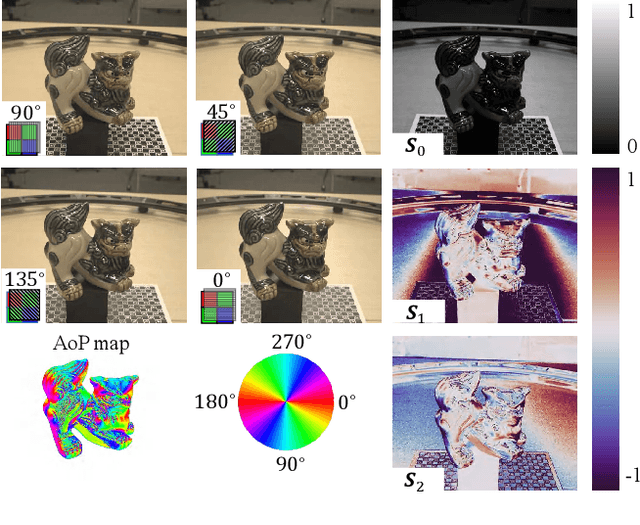

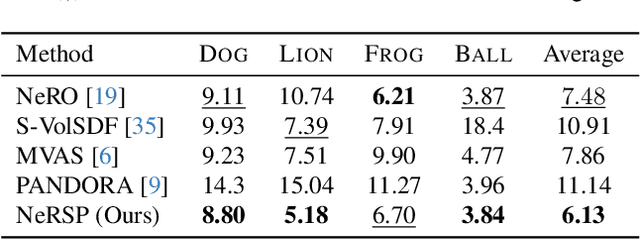
We present NeRSP, a Neural 3D reconstruction technique for Reflective surfaces with Sparse Polarized images. Reflective surface reconstruction is extremely challenging as specular reflections are view-dependent and thus violate the multiview consistency for multiview stereo. On the other hand, sparse image inputs, as a practical capture setting, commonly cause incomplete or distorted results due to the lack of correspondence matching. This paper jointly handles the challenges from sparse inputs and reflective surfaces by leveraging polarized images. We derive photometric and geometric cues from the polarimetric image formation model and multiview azimuth consistency, which jointly optimize the surface geometry modeled via implicit neural representation. Based on the experiments on our synthetic and real datasets, we achieve the state-of-the-art surface reconstruction results with only 6 views as input.